Designing the platform behind Sonar's shift from one product to seven
As AI coding agents became mainstream, Sonar's role expanded. With roughly 42% of all committed code now AI-generated or assisted, the challenge shifted from helping developers write better code to verifying code at a scale and speed no human reviewer can match. Sonar's provides a Guide → Verify → Solve approach that wraps around AI agents — setting them up with the right context before they write, catching issues in real time as they generate, and automatically remediating what they get wrong. Customers include ServiceNow, Booking.com, Deutsche Bank, Nasa, AstraZeneca, etc..
Project type
Product design
Location
Geneva, Switzerland
Role
Staff product designer + cross team coordenation
Company
Sonar
Industry
Dev tools
Timeline
6 months

About Sonar
Sonar provides code analysis for quality, security, and maintainability issues. It's used by companies like Nvidia, Goldman Sachs, and Ford.
Sonar sits inside the development pipeline of more than 7 million developers, analyzing upward of 750 billion lines of code a day. Over three-quarters of the Fortune 100 run on it, across finance, automotive, and technology organizations where a missed vulnerability or an unreviewed regression isn't a minor bug, it's a liability. That's the scale the platform in this case study had to work at, before AI ever entered the picture.
7M+
Developers
400,000+
Organizations
750 billion
Lines of code analyzed daily
Sonar's whole job was helping developers write and verify code.
For most of its history, Sonar had one job: verify code before it reached production. SonarQube — self-managed as Server, hosted as Cloud — sat inside the CI/CD pipeline and caught bugs, vulnerabilities, and maintainability issues in code a developer had written by hand. Simple premise, understood by every customer: humans write it, Sonar checks it.

WITH AI
Sonar changed its strategy from developer centric
to agent development centric

Sonar invested in two aquisitions and five new products
They became a multi-product company
Building out Guide and Solve meant moving faster than any single team could build alone. Sonar acquired Tidelift — open-source supply chain security — in December 2024, extending Guide's context to code developers hadn't written themselves. It acquired Gitar — AI-native code review — in May 2026, extending Solve into automated post-generation review. Combined with what Sonar built internally, the company that had shipped one product for over a decade was now shipping seven, each covering a different moment in the AI development cycle.

My role
I designed the platform that held it all together
I led the design of a shared platform layout and navigation system, built to give every product, present and future, the same wayfinding logic, while staying flexible enough to absorb a newly acquired product without a redesign each time. I worked with product teams across the company, including the incoming Gitar and Tidelift teams, to fold their products into the system rather than beside it. I rebuilt the settings experience under the same logic, organized around user tasks instead of internal team ownership, so configuration could scale the way navigation did. Rather than a hard cutover, the new experience shipped behind a feature flag, letting users opt in gradually while we gathered real feedback.
meta-data
Object identifier
Group label
Group label
▣ Collapse
Process
Whatever I designed had to hold onto what already made Sonar, Sonar.
Before designing anything, I looked for what was already, permanently, Sonar. Concepts like quality gates, the pass or fail check that had anchored every product's relationship with code for years, weren't going anywhere, regardless of which new product or acquisition joined the platform. Those principles became the foundation to design around rather than something to work around. From there I ran a competitive benchmark of how other multi-product platforms handled navigation at scale, pulled together the feedback Customer Success already had from users, and audited every surface across Server, Cloud, and the products coming in through acquisition, to tell which inconsistencies were structural and which were just cosmetic.

Solution
Here's what the new platform actually did
The new layout wasn't one feature, it was a set of decisions that had to work together. Each one solved a different piece of the fragmentation problem: how an enterprise customer moves between organizations, how settings scale without turning into a junk drawer, how a new product gets discovered instead of hidden, and how the next designer joining the team knows where anything fits.
Enterprise ready
Improved IA
Product navigation
Platform guidelines
New products inherit enterprise readiness by default (permissions, roles, multi-org access), plus the organization switcher for enterprise users moving between orgs.

How we tested it?
Beta access, real feedback, and a gradual feature flagged opt-in
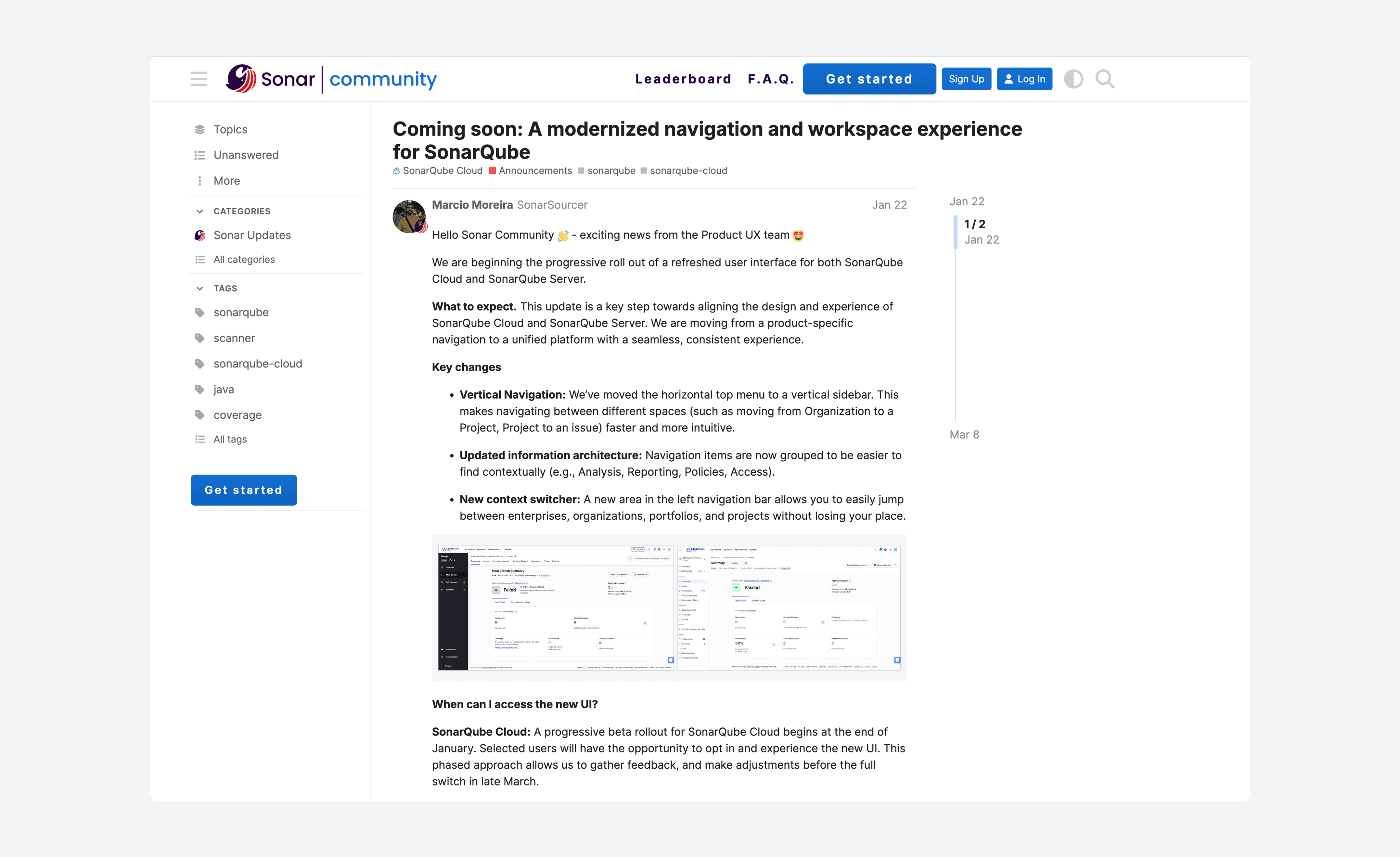
A redesign touching navigation across every product wasn't something to hand every customer on the same day. We shipped it in Beta first, behind a feature flag customers could opt into rather than have imposed on them. Public announcements ran ahead of the rollout, so nobody found a new sidebar for the first time in the middle of their own work. Once real usage started, an embedded Sprig survey collected structured feedback directly inside the product, alongside whatever came in through support. Most of what came back was bugs and small suggestions, not a reason to rethink the approach, so as issues got fixed we widened the percentage of customers eligible to opt in, batch by batch, until the flag came out entirely.
Outcome
98% of users never went back to the old one.
Of the users who tried the new experience, 98% chose to stay rather than opt back out. Sprig survey responses consistently pointed to the same thing: clarity, easier navigation. And when Gitar and Tidelift landed inside the platform, they landed on a system already built to hold them, instead of triggering another round of layout decisions. That was the real test: not whether the system worked on day one, but whether it kept working as the company kept changing.
Only 2%
Opted-out in Beta
+140
Survey participants
+40,000
Daily users on the new layout